Which Laboratory Glasswashers Deliver the Highest Purity and efficiency? The answer to this question lies in choosing precision-engineered Laboratory Glasswashers, such as the industry-leading models available from Miele and Smeg within The Scientific Instrument Centre (SIC). Contamination, even at the trace level, can invalidate months of lab work. It is here that the importance of modern Laboratory Glasswashers becomes so important.
At SIC, we understand that a ‘one-size-fits-all’ approach does not work in UK laboratories. We have curated a comprehensive range of Laboratory Glasswashers, featuring industry-leading models from Miele and Smeg. This will ensure that whether you run a dedicated central wash-up facility in a major research institute or a small teaching lab in a university, you can achieve certified, reproducible cleaning results without compromising on efficiency or safety.
The Mandate for Analytically Pure Glassware
The transition from manual washing methods to automated systems helped greatly to maintain high standards of scientific rigour. Taking the human risk element out of the equation meant the end of factors such as operator fatigue, inconsistent scrubbing techniques, and varying rinse durations, which made cleaning processes extremely difficult and posed a significant risk to data quality.
The beauty of a dedicated Laboratory Glasswasher is that it delivers consistent, repeatable cleaning cycles every single time you use it. These machines efficiently tackle complex soiling, from inorganic chemical residues and organic matter to biological contaminants, using precision-dosed detergents, controlled pressures, and verified thermal disinfection.
These machines have key features, such as integrated conductivity meters to ensure the final rinse is truly residue-free, providing measurable evidence that the glassware is analytically pure and ready for sensitive assays. This reliable, consistent output is at the heart of any Quality Assurance (QA) protocol. It is essential for laboratories operating under stringent regulatory frameworks such as GLP (Good Laboratory Practice) and GMP (Good Manufacturing Practice).
Transforming Operational Efficiency and Labour Costs
In any busy laboratory, technician time is the most valuable and finite resource. Diverting skilled personnel to the time-consuming task of manual glassware cleaning is an inefficient use of their specialist expertise. Automated equipment cleaning offers immediate, significant benefits to a laboratory’s workflow and bottom line.
An automated system effectively reclaims hours of valuable research time. A technician can load a large volume of mixed glassware into a single cycle and initiate a validated cleaning programme in a fraction of the time it would take to scrub and rinse each item manually. The machine then completes the complex process, freeing up the operator to concentrate on high-value tasks, such as experiment planning, data analysis, or sample preparation.
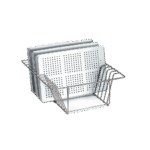
Our range of advanced Laboratory Glasswashers is designed for maximum throughput, ease of use, speed and space efficiency. Features like Miele’s proprietary EasyLoad system or Smeg’s versatile racking options simplify securing complex items, such as narrow-necked flasks, pipettes, and measuring cylinders, over injection nozzles. This not only speeds up loading but crucially, reduces the risk of breakages, saving the laboratory money on replacement glassware over time.
Our Range is Engineered for Every Laboratory Scale
Our partnership with Miele and Smeg allows us to offer Laboratory Glasswashers that scale perfectly with the unique needs of your organisation. Whether you require a compact under-bench unit for a small department or a full-scale floor model for industrial throughput, we have a solution that combines exceptional build quality with sophisticated wash technology.
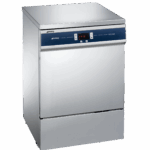
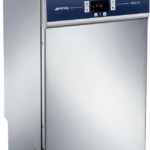
The Smeg GW0260-00-00J – The Compact Workhorse
For smaller facilities, academic teaching labs, or dedicated Quality Control (QC) satellite laboratories, space efficiency and cost-effectiveness are paramount. The Smeg Laboratory Glasswasher GW0260-00-00J is the ideal solution.
This 60cm, under-bench model is built with durability in mind, featuring high-grade AISI 304 stainless steel for both the external casing and the wash chamber. While compact, it offers surprising flexibility with capacity for up to two independent washing levels, accommodating a versatile mix of small beakers, test tubes, and volumetric flasks.
Key features include an intuitive colour touch display, seven pre-set standard cleaning programmes, and thermal disinfection capabilities reaching up to 85°C. A particularly valuable asset for small labs, it features a USB input for data logging, allowing users to download cycle details for essential process documentation and audit trails.
Best for: Small Academic Labs, University Teaching Facilities, and Dedicated Agro-Food or Routine QC Laboratories requiring a robust, reliable, and space-saving solution for daily, mixed-load cleaning with basic traceability.
The Miele PLW 8617 – The High-Throughput Compliance Centre
At the other end of the scale, large-scale research environments—especially those involved in regulated industries like pharmaceuticals, biotechnology, or contract research organisations (CROs)- demand machines with immense capacity, advanced process control, and absolute traceability. The Miele Laboratory Glasswasher PLW 8617 is engineered precisely for this demanding environment.
The PLW 8617 is a large-chamber, floor-standing unit (1150 mm wide). It can reprocess staggering volumes of labware, including up to 216 laboratory flasks or 588 vials per cycle. It represents the pinnacle of Miele’s PerformanceLine range, incorporating a suite of features designed for analytically pure results:
- 2-Pump Technology: A smart, variable-speed pump system dynamically adjusts wash pressure and water volume to suit the specific load and soiling level, ensuring intense cleaning while achieving up to 60% water savings in particular programmes.
- Conductivity Monitoring: This machine features integrated sensors that continuously measure the conductivity of the final rinse, ensuring that ionic residues, which could interfere with sensitive chemical or biological analyses, are entirely removed.
- HEPA-Filtered Drying: A high-performance hot-air drying system featuring a HEPA H14 filter ensures clean air, free of airborne particles, is circulated throughout the chamber. This eliminates the risk of re-contamination during the drying phase, leaving glassware streak-free and ready for immediate use.
- Advanced Documentation: The 7-inch colour touch display and PLC controls offer up to 200 programmable memory slots and sophisticated connectivity (USB/Ethernet) to support rigorous process documentation required for GLP/GMP compliance and 21 CFR Part 11 regulations.
This machine is best for: Large Pharmaceutical R&D Centres, Centralised Research Institute Wash-Up Facilities, and High-Throughput Industrial Laboratories where capacity, process validation, critical purity, and regulatory compliance are essential.
Conclusion
The choice of a Laboratory Glasswasher is one of the most critical decisions a scientific facility can make. It is an investment in the reliability of your data, the efficiency of your staff, and the long-term success of your research programmes.
Our curated range of Miele and Smeg models provides UK laboratories with cutting-edge technology, from reliable, compact solutions to high-compliance, high-capacity titans.
We offer an end-to-end service, from consultation and installation to nationwide support and maintenance from our manufacturer-trained engineers. By choosing to integrate a high-performance Laboratory Glasswasher into your workflow, you are assuring purity, maximising productivity, and reinforcing the integrity of your scientific mission for years to come.To discuss the specific requirements of your facility and to identify the perfect Smeg or Miele model to elevate your laboratory standards, contact us today.